English

Intent
At Oaklands Community Primary School, our English curriculum forms around the belief that all pupils can become confident, fluent and purposeful communicators. Our intent is to develop pupils who can speak, read and write with clarity, accuracy and independence, equipping them with the essential literacy skills needed for both academic success and everyday life. The ability to express ourselves effectively gives children a voice, and therefore opportunities to share their ideas with the world.
Within Key Stage 1, dictation is used deliberately as a core pedagogical approach to build the foundational skills of writing while carefully managing cognitive load. Pupils are guided to transcribe sentences that model accurate spelling, punctuation and sentence structure, allowing them to focus their attention on securing essential transcriptional knowledge without the additional demands of idea generation. Through repeated, structured dictation, pupils develop automaticity in phonics, common exception words, and basic grammatical constructions, ensuring these skills become embedded and readily retrievable. As pupils move through KS1, dictation is gradually reduced as a scaffold, with increasing opportunities for pupils to apply their knowledge independently. This carefully sequenced release ensures that by the end of Year 2, pupils have a secure, fluent grasp of the foundational components of writing, enabling them to enter Key Stage 2 ready to write with greater independence, confidence and control.
In Key Stage 2, writing is developed through carefully sequenced “small steps” that build pupils’ grammatical knowledge year on year, ensuring depth, not overload. Each year group revisits and extends prior learning, enabling pupils to understand, apply and manipulate grammar increasingly independently within their writing. While pupils are encouraged to generate and develop their own ideas with growing confidence, dictation remains an important tool for teacher modelling and guided practice, reinforcing accuracy in transcription and exposing pupils to high-quality sentence structures. This balanced approach ensures that by the end of Key Stage 2, pupils can draw upon a secure grammatical foundation and write with independence, control and deliberate choice.
Implementation
At Oaklands Community Primary School, our English curriculum is implemented through a structured, progressive approach that develops pupils as confident, fluent and purposeful communicators. From the moment children begin in EYFS, a strong emphasis is placed on the development of early reading and transcription skills. Phonics is taught using a systematic synthetic approach through the Little Wandle scheme, ensuring children develop secure word reading and spelling foundations. Daily teaching, alongside timely and effective intervention, ensures that all pupils are supported to keep up and succeed.
Across the school, spelling is taught explicitly and progressively, beginning with ‘tricky words’ in EYFS and developing into a clear sequence of spelling patterns, rules and morphological understanding. This supports pupils in building accuracy and confidence in their written work.
A core element of our implementation is the deliberate use of dictation and transcription, particularly within Key Stage 1. Carefully structured dictation enables pupils to practise and embed phonics, spelling, punctuation and sentence construction while reducing cognitive load. Teachers model and guide pupils through these processes, ensuring foundational skills become automatic. As pupils move through KS1, dictation is gradually reduced, allowing increasing independence in composition and preparing pupils effectively for Key Stage 2.
In Key Stage 2, learning is carefully sequenced through the small steps approach outlined in the July 2025 Writing Framework. Teachers explicitly model grammatical concepts, sentence construction and vocabulary choices, before guiding pupils through supported practice towards independent application. Prior learning is continually revisited and built upon, ensuring depth of understanding and secure progression. While pupils are encouraged to generate and develop their own ideas, dictation remains an important tool for modelling, rehearsal and reinforcing accuracy.
Reading is central to the curriculum and underpins writing development. All children participate in daily reading sessions, including whole-class teaching, guided practice and comprehension. High-quality texts are carefully selected to expose pupils to rich vocabulary, varied structures and a wide range of genres. A daily read-aloud promotes a love of reading, while regular opportunities to read independently support fluency and comprehension. As pupils progress, they are encouraged to read widely across fiction and non-fiction, supported by structured programmes such as Accelerated Reader. Targeted interventions ensure all pupils are able to access and succeed in reading.
Writing is taught through carefully chosen model texts, which provide clear examples of language, structure and purpose. Teachers use shared writing to demonstrate the writing process, including transcriptional and compositional skills. Pupils are given regular opportunities to discuss, plan, write, edit and publish their work for a clear audience and purpose, promoting independence and pride in their writing.
Oracy and vocabulary development are woven throughout the curriculum. Through discussion, structured talk and explicit teaching, pupils develop the language needed to articulate their ideas clearly. Classrooms promote a rich language environment where new vocabulary is explored, displayed and applied across contexts.
Through high-quality teaching, consistent routines and timely intervention, our implementation ensures that all pupils develop the knowledge, skills and confidence needed to read widely, write effectively and communicate with clarity and purpose.
Impact
- Children are competent communicators and have a vast knowledge of vocabulary.
- All children make at least good or accelerated progress in their English development.
- Children have an awareness of a variety of authors and genres and be able to voice their love of reading.
- Our children are enthusiastic writers and produce quality extended writing.
- The school’s results for the Phonics Screening Check and end of Key Stage 1 & 2 English results compare favourably to that of the national data.
- Children’s literacy skills support them to access the wider curriculum and the next stage of their education.
- Staff are competent when teaching the key components of reading.
- Children are actively taught the skills to become able readers through focussed group reading sessions.
- Our children are able to use and understand subject-specific vocabulary when discussing reading, for example, prosody, fluency, expression, use of punctuation.
- Following training, our staff are able to use a variety of teaching methods to improve prosody, such as echo reading, choral reading, buddy reading.
- Reading progress is regularly monitored to ensure that interventions can be implemented quickly and effectively.
- We offer our children a well-stocked library which contains a vast array of reading materials to enable our pupils to explore and study varied genres.
- Our pupil voices are heard regularly and reflect the love and enthusiasm our children have for reading.
Phonics
At Oaklands, we believe that all our children can become fluent readers and writers. This is why we teach early reading through Little Wandle Letters and Sounds Revised, a systematic and synthetic phonics programme. We start teaching phonics in Reception and rigorously follow the Little Wandle Letters and Sounds Revised progression. As a result, all our children are able to tackle any unfamiliar words as they read. We also model the application of the alphabetic code through shared reading and writing, both inside and outside the phonics lesson and across the curriculum.
We have a strong focus on language development for our children because we know that speaking and listening are crucial skills for reading and writing in all subjects. Moreover, we value reading as a crucial life skill, and so we ensure that our readers are equipped with the tools to tackle unfamiliar vocabulary, which allows our children to see themselves as readers for both pleasure and purpose.
Children at Oaklands therefore make a strong start in Reception, where the teaching of phonics begins in week 1 and any child who needs additional practice has daily 'keep-up support'.
For further details of the progression of phonics, please click here
Assessment
Assessment is used to monitor and to identify any child needing additional support as soon as they need it. Keep-up support then happens daily. Summative assessment is used every six weeks to assess progress and identify any children needing additional support. A placement assessment is used with any child new to the school in Reception and Year 1 to inform teaching. Fluency assessments are used throughout the school and children are supported with rapid-catch-up interventions to ensure that no child is left behind.
Phonics Screening Check
Every Year 1 child in the summer term will take the National Phonics Screening Check. This is a phonics-based check where children will be expected to read 40 simple, decodable words including nonsense, or alien, words. This is a progress check to identify those children not at the expected level in their reading. Children will be rechecked in Year 2 if they do not reach the expected level and will be supported with appropriate intervention.
Phonics Screening Check Information
Inclusion
Teachers include all pupils fully in their daily phonic lessons. All children benefit from participating in watching, and listening to other children demonstrating and explaining their ideas. Differentiated work, appropriate to individual children’s needs, is provided in the independent work during the day and also during intervention sessions.
Early Reading
“The more that you read, the more things you know. The more that you learn, the more places you’ll go!” – Dr Seuss.
At Oaklands Community Primary School, we value reading as a crucial life skill. We ensure that our readers are equipped with the tools to tackle unfamiliar vocabulary. We ensure our children see themselves as readers for both pleasure and purpose.
Enjoying books and reading stories from a very early age is crucial in the development of children. It helps with their ability to understand words, use their imagination and develop their speech, as well as being something they really enjoy. We ensure that children have exposure to a broad range of authors through our 'Explore an Author' termly themes.
Teachers and parents play a huge part in the development of reading skills in young children. The more children experience books, the more they will gain interest and passion for them. Reading offers so much more than just quiet time in a cosy corner. It helps to develop social skills through the further development of speaking and listening, as well as all aspects of literacy that as adults we take for granted. As a result, young children need to be able to experience books; they need to be able to understand and enjoy stories, books, rhymes and songs and listen and respond to them with curiosity and enjoyment. This will promote the value and pleasure of reading and encourage an interest in reading throughout school and in later life.
Teaching reading
Each reading practice session has a clear focus: decoding, prosody and comprehension.
Home reading
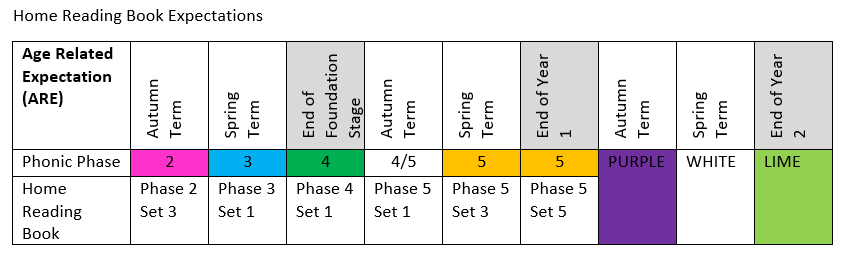
At Oaklands, we follow a system of books that are colour-banded and linked to the phonic phases that have previously been taught. These are then fully decodable so that children are able to decode with ease and develop their prosody and fluency skills. We identify where the children should be at the end of the year to ensure all staff know the end goal.
The decodable reading practice book is taken home to ensure success is shared with the family. Children also take home a Reading for Pleasure book for adults to share with them. In school, class teachers read to children every day; we choose these books carefully as we want children to experience a wide range of books.
Your child’s reading is closely monitored and once your child has completed the Little Wandle, Letters and Sounds Revised phonics programme, they will progress through a variety of book band colours, finishing on Lime. They will then become part of our 'Free Reader Hall of Fame!' where pupils can select small chapter books to build their reading stamina. This is generally towards the end of Year 2.
The table below indicates the expected level of home reading books that children should be able to read at the end of each term:
Key Stage 2 Reading
Reading is important. Children are taught the skill of reading through guided reading as well as staff giving children the opportunity to read independently, to others and with an adult. We ensure that children have exposure to a broad range of authors through our 'Explore an Author' termly themes. For more information, please click here.
At Oaklands, in Key Stage 2, we use Accelerated Reader to support children's independent reading to ensure books are closely matched to their ability.
What is Accelerated Reader?
Accelerated Reader (AR) is a computer program that helps teachers to manage and monitor children’s independent reading practice. Your child picks a book at his/her own level and reads it at his/her own pace. When finished, your child takes a short quiz on the computer - passing the quiz is an indication that your child has understood what has been read.
Adults may assist pupils in the following ways:
• Guiding them to books appropriate to their ability and interests
• Asking probing questions as your child reads and before quizzing
• Pairing your child with others, reading with or reading to your child
Since they are reading books at their own reading and interest levels, most children are likely to be successful and enjoy the books and quizzes. Best of all, they learn and grow at their own pace.
How can I help my child become a better reader?
As with anything, performance improves with practice. According to Renaissance Learning’s research, children who read at least 20 minutes a day with a 90% comprehension rate on AR quizzes see the greatest gains. Encourage your child to read at home, discuss books, ask questions about what they have read and visit your local library.
What is a Star Reading test?
Star Reading is used to determine your child’s reading level. It is a computer-based reading assessment program that uses computer-adaptive technology. Questions continually adjust to your child’s responses. If the child’s response is correct, the difficulty level is increased. If the child cannot answer a question or answers incorrectly, the difficulty level is reduced. The test uses multiple-choice questions and takes approximately 20 minutes to complete.
What is a Book Level?
Book Levels are reported using a readability formula and represent the difficulty of the text. The levels range from 0.5–13.5. Books are chosen based on the ZPD range recommended for each pupil by Star Reading.
| Age Related Expectation (ARE) |
Range in Year 3 |
End of Year 3 | End of Year 4 | End of Year 5 | End of Year 6 | Reading Beyond… |
| Home Reading Book | 3.0 -3.5 | 3.5 | 4.5 | 5.5 | 6.5 | >6.5 |
Writing
At Oaklands Community Primary School, we believe that every child can become a confident and successful writer. Our writing curriculum develops pupils' ability to communicate clearly, accurately and independently, giving them the skills they need for learning and everyday life.
Writing is taught through a carefully planned and progressive approach. In EYFS and Key Stage 1, pupils build strong foundations in phonics, spelling, sentence construction and transcription. Structured dictation helps pupils practise and secure these essential skills, developing accuracy and fluency before moving towards more independent writing.
In Key Stage 2, pupils continue to develop their writing through carefully sequenced small steps. Teachers model grammar, language and composition, while high-quality texts provide examples of effective writing. Pupils are encouraged to generate, develop and refine their own ideas, becoming increasingly independent, confident and purposeful writers.
Handwriting is taught consistently through the Letter-join scheme, enabling pupils to develop fluent, legible and joined handwriting. High expectations for presentation are promoted across the curriculum.
Reading, vocabulary development and oracy underpin writing throughout the school. Through exposure to high-quality texts, rich discussion and explicit vocabulary teaching, pupils develop the knowledge and language needed to write effectively for a range of audiences and purposes.
Through high-quality teaching, consistent routines and targeted support, we ensure that all pupils develop the skills, confidence and independence needed to become successful readers, writers and communicators.
Assessment
Children apply their writing across the curriculum and their independent writing is assessed termly. This is based on the Standards & Testing Agency (STA) Writing Assessment Framework and writing objectives. Alongside writing moderations within school, writing is also moderated by a variety of local schools.
Intervention
Regular monitoring of the assessment outcomes allows teachers to ensure that all children are making expected progress and allows early intervention to be put into place for those children falling behind the expected standard. Depending on the needs of individuals, this may include specific phonic and spelling support, handwriting support and/or additional individual or small group tutoring. It is important that children who are struggling to learn to write not only need to catch up with their peers, but also continue to make progress.
Inclusion
Our aim is that every child’s needs are catered for, and every child is given the chance to succeed and become a competent writer. We give every child the opportunity to experience success in learning and to be the best that they can be. Work is matched to individual children’s needs.